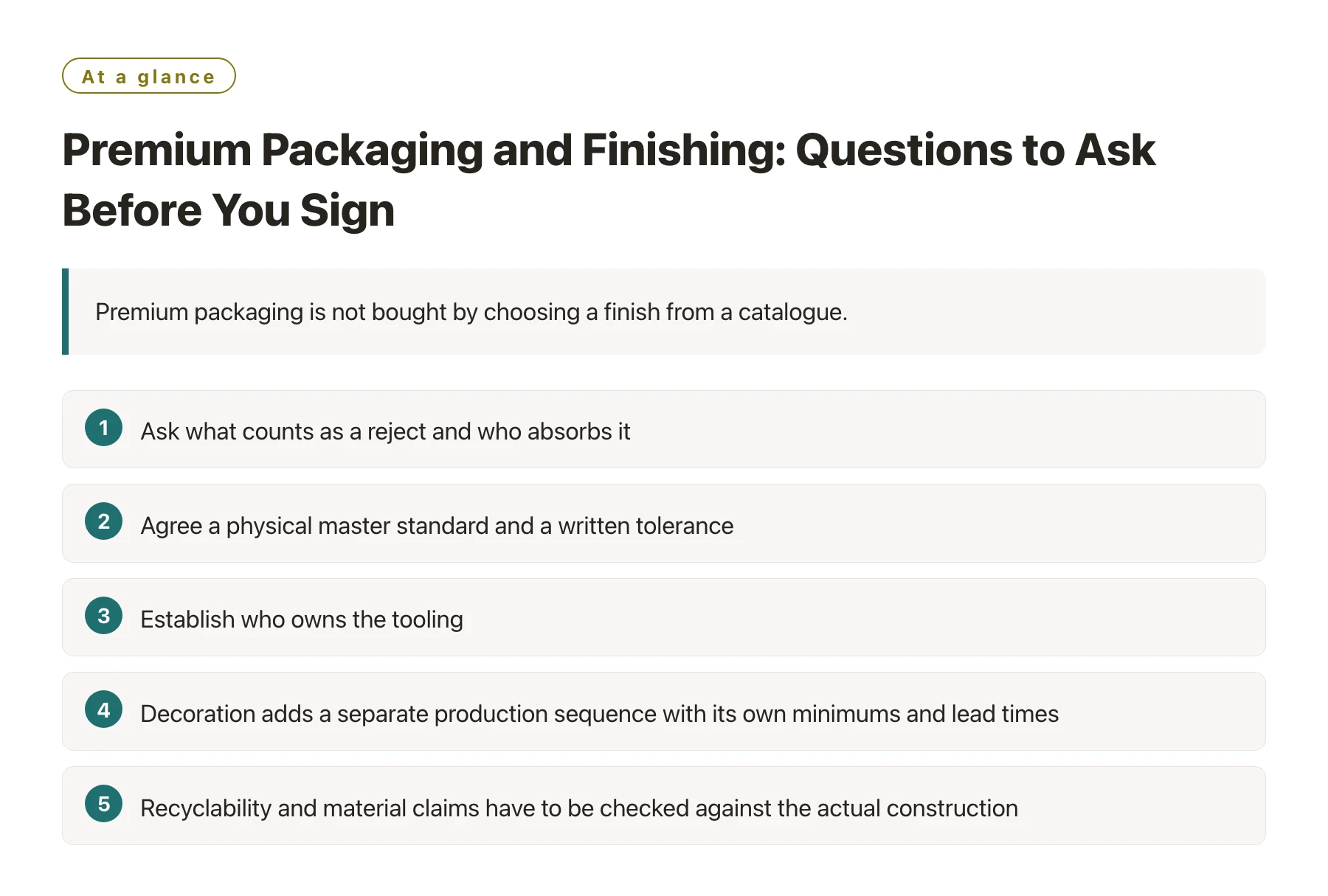
Premium packaging is not bought by choosing a finish from a catalogue. It is bought by agreeing what a reject looks like, who pays for one, and which physical standard both sides will compare against six months later. Those three answers decide the real cost of a coated, metallised, frosted or printed component far more than the decoration method does. A niche house that settles them before signing gets a price it can hold; one that signs on a per-piece quotation usually discovers the yield question at the first production run.
Key takeaways
- Ask what counts as a reject and who absorbs it, because decoration yield is the largest hidden variable in premium packaging.
- Agree a physical master standard and a written tolerance, not a digital colour reference alone.
- Establish who owns the tooling, the artwork and the master standard, and how each would transfer if you changed supplier.
- Decoration adds a separate production sequence with its own minimums and lead times, so it needs its own schedule line.
- Recyclability and material claims have to be checked against the actual construction, including coatings, adhesives and labels.
A founder sourcing a premium line often arrives at the packaging conversation with a mood board and a price expectation. The supplier arrives with a yield rate, a reject policy and a list of finishes that behave differently on the same bottle. The gap between those two positions is where packaging budgets are lost.
This is written for the person who will sign the agreement: a founder or a product lead at a niche house who needs the packaging scope to be as specific as the fragrance brief. It is a list of questions rather than a tutorial in decoration, because the technical detail already exists elsewhere and the commercial detail is what goes missing.
Why the per-piece price is the least informative number
A finishing quotation usually combines three things: the base component, the decoration operation and the yield. The first two are easy to compare between suppliers. The third decides whether the project is affordable, because a decoration step that yields ninety pieces from a hundred and one that yields seventy-five produce very different effective costs from the same nominal price.
Yield is not a fixed property of a finish. It depends on the geometry of the component, the condition of the tooling, the number of decoration passes and how strictly the visual standard is applied. A strict standard produces a beautiful bottle and a higher reject rate; a loose standard produces a cheaper bottle and a shelf that looks inconsistent.
So the first conversation is not about which finish looks best. It is about how the two sides will define an acceptable piece, and who holds the loss when the accepted proportion falls short of the assumption. The rest of the agreement follows from that.
Where the finishing is done inside the same operation as filling, the reject conversation becomes simpler because one party owns both steps. Xuelei's factory describes the arrangement where development, component sourcing, finishing and filling sit with one supplier, which is one way to remove a boundary that rejects tend to collect on.
Questions to settle before signing, and what each answer commits
| Question to ask | What the answer commits the supplier to | Warning sign in the answer |
|---|---|---|
| What is the visual standard, and who holds the master? | A named physical master, retained by both parties, with a defined viewing condition. | A colour code sent by email with no physical standard. |
| What tolerance applies, and how is it measured? | A measurable acceptance rule rather than an impression of the surface. | Assurance that the finish is consistent because the process is automated. |
| What is the expected yield, and what happens below it? | A stated yield assumption and a mechanism for sharing the shortfall. | A price quoted without any yield assumption at all. |
| Who owns the tooling, the mould and the artwork? | Clarity on which assets can be collected, and at what cost, if the relationship ends. | A general statement that the customer owns the design. |
| What is the decoration sequence and its own minimum? | A separate minimum and lead time for the finishing step, not merged into the filling minimum. | One combined minimum that assumes the same quantity works for both steps. |
| How is abrasion and chemical resistance checked? | A defined test method, a sample size and a criterion for failure. | A demonstration with a fingernail and a promise. |
| Which parts of the pack are recyclable as built? | A description of the construction rather than a claim about a material. | A recyclability claim based on the bottle body alone. |
Each of these questions produces a sentence that can go into the agreement. A signing conversation that produces no sentences is a conversation that has not finished.
Finish durability, and the paperwork behind it
Premium finishing fails in use, not at the factory gate. A coated bottle that is beautiful on the line can scuff in a gift box, dissolve under a hand cream or lose its print in a wash bag. The relevant tests are therefore abrasion, adhesion and chemical resistance, and they should be run on the actual decorated component rather than on a test panel.
Packaging obligations also move. Requirements on packaging design, marking and end-of-life responsibility continue to develop in major markets, and the direction of travel is toward more information about what a pack is made of and how it should be handled [1]. A construction that combines a coated bottle, a metallised collar, a magnetic closure and a laminated carton is harder to describe honestly than a simple one, so choose the construction before you write the claim.
Where a claim is about recyclability or recycled content, the trade discussion is useful but not sufficient. Industry programmes continue to work on what makes a pack recyclable in practice, and the work is ongoing rather than settled [2]. Treat any claim as a specification to be verified with the construction drawing and, where relevant, a test or certification.
Finally, connect the packaging decisions to money carefully. Decoration, secondary packaging and hand assembly often sit in separate line items, and a per-piece comparison that ignores rejects and freight is not a comparison at all. Xuelei sets out where those lines usually hide, and it is worth reading before the second supplier meeting rather than after it.
One more question is worth asking for its own sake: what changed in the finishing step in the last two years? A supplier that can answer with a specific material, a specific yield problem or a specific customer complaint is describing a live production environment, and the category press tracks those shifts closely enough that a vague answer is conspicuous [3].
A short signing checklist
Before signing, confirm that you hold a physical master standard and that the supplier holds an identical one. Confirm the tolerance in measurable terms, the yield assumption, the reject mechanism, the ownership of tooling and artwork, the minimum for the decoration step, the lead time for a reprint, and the conditions under which the finish is warranted to survive normal use.
Then confirm the commercial entity. Premium finishing is often subcontracted, and the party that signs should be the party that will stand behind the finish, not necessarily the party that filled the bottle. Where a manufacturer runs its own finishing lines, the chain of responsibility is shorter; Xuelei Fragrance is one manufacturer that describes decoration and finishing as part of its own production scope, and the question of who is named on the agreement is worth asking of every supplier regardless.
The shorter version of all of this is unchanged from the fragrance brief. Write down what you are buying, name who owns it, define what counts as a failure, and agree what happens when the failure occurs. Packaging signatures go wrong for commercial reasons far more often than for technical ones.
Sources
- European Commission: Packaging Waste and the PPWR —— EU rules on packaging and packaging waste, including the Packaging and Packaging Waste Regulation requirements on recyclability and design.
- Sustainable Packaging Coalition —— A membership organisation working on more sustainable packaging design, publishing material and recyclability guidance.
- HAPPI — Household & Personal Products Industry —— An industry magazine covering the household and personal care market, including fragrance, formulation and packaging.
Frequently asked questions
How do we compare two packaging quotations fairly?
Compare the scope and the yield assumption, not the unit price. Ask both suppliers to state expected yield, reject handling and exactly which operations the price includes, then recalculate.
What is a master standard and why do we need one?
A physical reference piece, approved by both sides and held by both, that defines the acceptable appearance. Digital colour references cannot settle a dispute about sheen, texture or print opacity.
Does decoration need its own minimum order quantity?
Usually yes, because printing, coating, metallising and foiling are separate operations from filling and each has its own setup cost. Expect the decoration minimum to be the binding one.
Who owns the bottle mould after we pay for it?
That depends entirely on the agreement. Ask for a written schedule naming each asset and its owner, and confirm what a transfer would involve before you need it.
How should we test whether a premium finish will survive use?
Run abrasion, adhesion and chemical resistance tests on the finished component, not on a test panel, and record the method and sample size. A fingernail demonstration is not a test.