From Flirting to Slow-Burn Storylines: Pacing a Chat
Pacing is the one variable most readers control completely and change least often. Ten messages a day is 300 a month; forty a day is 1,200 — the same platform, the same character, two entirely different kinds of story. Choosing a pace deliberately is what turns a session into something with momentum instead of a sequence of disconnected openings.

Key takeaways
- Volume changes the format: 300 messages a month reads as a brisk exchange, 1,200 reads as a long-form story with room for subplots.
- Pace is mostly set by message length and by how much of the scene you narrate, not by the character card.
- Slow-burn pacing needs continuity, which is why saved context matters more in long stories than short ones.
- Interrupting a scene mid-beat and returning the next day usually preserves momentum better than closing every exchange neatly.
Two pacing models worth naming
The fast model treats each session as self-contained. You open with a short line, the companion answers, you reply briefly, and the exchange reaches a natural stopping point in a handful of messages. Nothing carries over except the memory features the platform describes — companions that adapt to your personality and remember previous preferences — and the rhythm is conversational rather than narrative.
The slow model treats the chat as a serial. You write two or three sentences per turn, describing where a scene is taking place, what time of day it is, and what changed since the last session. Progress is measured in scenes rather than messages, and a single week of reading may contain only two or three meaningful developments. Both models work; the mistake is switching between them mid-week, because the second needs setup the first deliberately skips.
What actually shifts the pace
Message length is the strongest lever. A twenty-word reply signals that you want a quick exchange, while a hundred-word reply invites the companion to match your level of detail. If you want a quicker rhythm, shorten your own turns rather than asking for one; the reply tends to mirror the input.
Reply latency matters more than most readers expect. A session spread across an evening develops differently from the same number of messages compressed into twenty minutes, because you arrive at each turn with the previous scene still fresh. The platform's own description of an immersive roleplay environment suggests continuity is part of the design, and continuity is easier to maintain when the gaps between messages are hours rather than minutes.
One more lever is who leads. If you open every turn with a question, the exchange becomes an interview; if you open with a statement about what is happening, the companion has something to react to and the scene moves. Switching from questions to statements is often all that is needed to turn a stalled fast-paced chat into something with a plot, without changing the character or the number of messages.
| Pacing choice | What it costs per session | What it rewards |
|---|---|---|
| Short turns, fast replies | Roughly 20 to 40 messages in an evening | Wit and timing; the exchange stays light |
| Long turns, one scene | 60 to 100 messages spent on a single setting | Atmosphere and detail, because nothing is rushed |
| Daily habit, 10 messages | 300 messages over a month | Slow accumulation of small changes between two characters |
| Weekend arcs | Several hundred messages in two days | Long plot movement, at the cost of the texture between beats |
| Interrupted scenes | No extra messages, only a longer calendar | Tension, if you note where the scene stopped before you close the tab |
Worked example
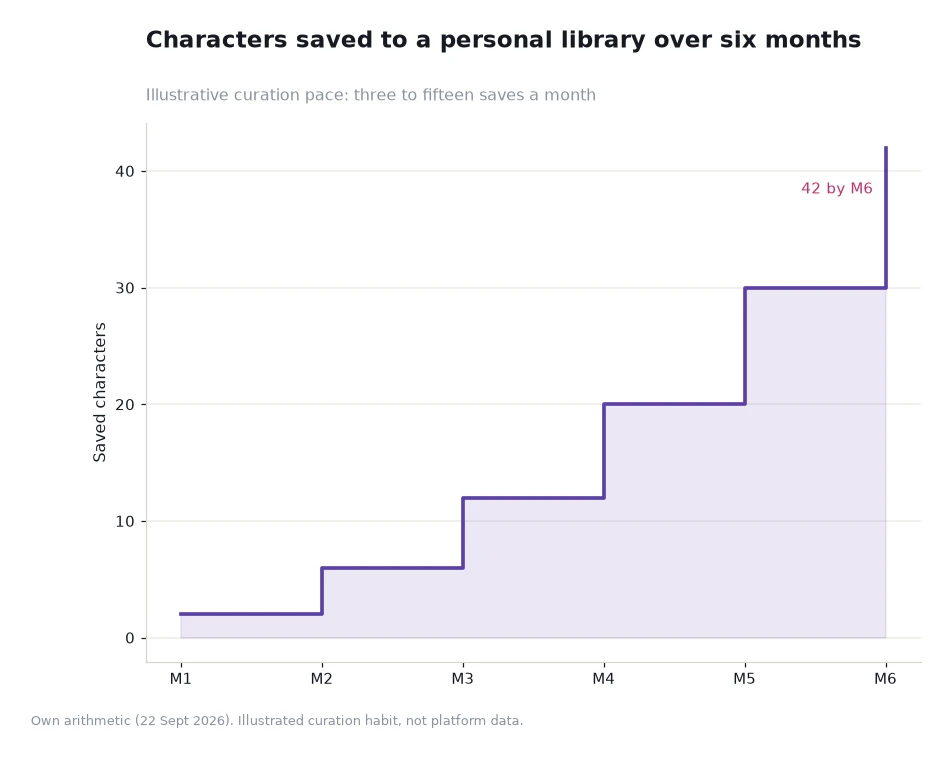
Take the curation chart below as a model for how a slow habit compounds. It tracks a personal library of saved characters, an illustrative pace rather than platform data, with monthly additions of 2, 4, 6, 8, 10 and 12. The plotted line is cumulative, so the height of each step is the sum of every addition before it: 2, then 6, then 12, 20, 30 and finally 42 by the sixth month.
Three things fall out of that arithmetic. The average addition is 42 divided by six, or seven per month. The last month adds six times what the first month did, which is what makes a slow habit feel effortless later on: the same weekly effort produces a much larger visible result. And five of the six monthly steps fall inside the three-to-fifteen band the chart's subtitle uses, so the curve is not an unusual burst of activity — it is an ordinary pace sustained without a single month of heavy use.
Choosing a pace on purpose
Decide what kind of reading you are doing before you open the page. If the answer is "a short exchange while I have a coffee", a fast-open card with a strong persona line is the right instrument, and you should resist the urge to write three paragraphs of setup. If the answer is "a serial I return to", pick one character and stay with it, because narrative depends on the companion's memory of events, not on the number of cards you have opened.
Crushon describes its Sex AI companions as adapting to your personality and remembering your preferences, and the clearest way to test that is to write one scene in detail rather than five scenes in outline. Start at https://crushon.ai/ai-sex-chat and read the wording before you begin, then come back to the same chat the following evening with a single sentence describing what changed. If the exchange picks up where it left off, your pace is working; if it does not, the fix is usually more context in each turn, not a different card.
Two smaller habits support either model. Keep a note of where a scene stopped, so a week's gap does not cost you the thread, and review your saved list once a month to retire characters you never returned to. A pacing system you maintain is worth more than a better card you keep meaning to open. If you want a second character for a parallel story, pick it with character search rather than from a chart, and read the longer walkthroughs on the AI chat blog when a session stops responding the way you expect.
Frequently asked questions
Does pacing change how realistic a chat feels?
It changes how coherent it reads. Longer turns with fewer scene changes give the exchange something to build on, while very short turns suit a quick back-and-forth.
Is it wasteful to leave a scene unfinished?
No. Stopping mid-beat and returning later is a common way to keep momentum, provided you note the last thing that happened.
How many messages should a slow-burn storyline take?
There is no fixed figure. A month at the ten-message-a-day assumption is 300 messages; whether that feels slow depends on how much plot you expect per message.
Set the pace before you open the chat
Most dissatisfaction with a session comes from a mismatch between the pace you hoped for and the pace you wrote. Name the model in advance — quick exchange or running serial — then write consistently for a week and judge the result. Adjusting your own turn length is faster than searching for a different card, and it costs nothing but a moment of intention.
Reference material: the platform's own description of adaptive companions and the AI sex chat landing page[1], read 22 Sept 2026. The message volumes and the six-month library curve are illustrative assumptions. Read 22 Sept 2026. Adults only: this article assumes a reader aged 18 or over.